
Golf for everyone
· Updated: · 6 min read
HOW THE VCG REVOLUTIONISED THE SPORT OF GOLF
The Association of Non-Club Golfers (VcG) is a real success story: for around three decades, it has enabled amateur players and newcomers to indulge their passion on courses across the country. Managing Director Marco Paeke explained to us why the VcG is probably the only club that is happy when members leave, and why, despite the coronavirus, the club is set for a truly record-breaking year.
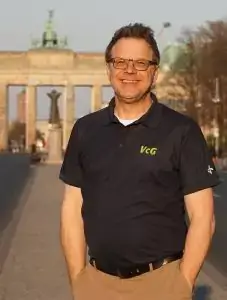
Playing golf without a membership
Spontaneously heading to a golf course on a business trip and unwinding from a stressful meeting with a round of golf? Before 1992, that wasn’t an option for everyone! “The problem with clubs was the long waiting lists and high fees,” says Marco Paeke. Due to concerns about the next generation and with the aim of ridding golf of its elitist image, the founding of the Association of Non-Club Golfers (VcG) was decided at the annual meeting of the German Golf Association (DGV). This opened up the sport to a wider group of interested people – a decision that initially met with little enthusiasm in the golfing community.

“The vote was a close call. Some members spoke of ‘barefoot golfers’, others feared the heritage of the sport of golf would be sold off cheaply,” explains the expert. In 1993, fewer than a third of the clubs organised within the DGV granted the ‘homeless’ players the right to play on their courses; in some cases, they charged double green fees. “My predecessors had to fight for playing permits and were delighted to gain access to driving ranges – today we offer a completely comprehensive service,” says Paeke. He should know: the long-standing golf club manager has been managing director of the VcG since 2007.
 Too many golf courses in Germany
The reason for the 180-degree turnaround by the long-established golf clubs: following a construction boom in the 1990s, supply soon outstripped demand. It is not without a certain irony that Paeke entered the industry for precisely this reason: a friend asked the trained travel agent whether, given his golfing experience, he could oversee the construction of a new course on the Baltic Sea – which he did, and where he immediately became club manager.
This was followed by roles in the Rheinhessen region and Berlin; for twelve years he was “director of a hotel without a roof”, as Paeke describes it, “you can’t keep that up for much longer.” With his move to the VcG, he swapped the clubhouse and club members for the quest to constantly seek out new trends and opportunities for the sport’s former “naysayers”. Tournaments for players of all ability levels, attractive introductory offers and youth development form part of the VcG’s broad spectrum – alongside its main goal: to get even more people excited about golf and make it easy to get started.
Golf during the coronavirus pandemic
“The VcG is open to anyone who wants to give golf a go,” explains Paeke. The target audience is a “diverse group”, as he puts it: one third consists of “occasional players” who pick up a club around four times a year, thereby saving on the cost of a club membership, and “local amateur golfers” who have families and also play other sports on the side. They are joined by the “exotics”, as Marco Paeke puts it in the finest Berlin dialect: “These are super-frequent players who play on lots of different courses.”
Whilst many other sports are struggling under the restrictive measures imposed by the authorities in the Covid-19 year of 2020, the VcG is seeing an exceptionally strong increase in membership. By the end of the year, around 24,000 golfers will be registered, an increase of almost six per cent compared to 2019. With business trips cancelled, many golfers were able to spend more time on the green. An incredible turnaround, given that during the first lockdown in the spring there were “hardly any new members”, as Paeke reports: “I really hadn’t believed that the season would end on such a positive note. I am aware that we are a privileged exception.”

Soaring on the green
One reason for the upturn in golf: it ticks all the boxes for a safe sport during the pandemic. “You’re out in the fresh air, and you have to keep your distance anyway, otherwise you’d get a club to the head,” laughs Paeke. Players simply have to do without the handshakes at the end of the round and a few other customary rituals surrounding the game. “The more that takes place in the digital space, the more I notice the days spent on the golf course,” reports the VcG managing director, who prefers to play with friends to leave everyday life and coronavirus worries behind for a while.
Despite – or perhaps precisely because of – these advantages, the Association of Non-Club Golfers also sees members leaving every year. And it welcomes this. Around twelve per cent of members leave the VcG at the end of the year. Half of them have enjoyed the sport so much that they join a local golf club straight away. “We encourage these moves. Such resignations are actually encouraged,” says Marco Paeke. “At the VcG, you pay for every round. So if you play on a course more often, club membership is worth it.” Through these natural transfers and extensive youth development, the association also plays a part in ensuring that the German Golf Association ranks among the ten largest sports associations in Germany.
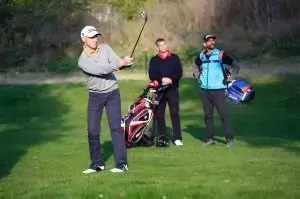
To strengthen this development, Marco Paeke is always on the lookout for innovative trends. The latest discovery from Switzerland: a twelve-hole round of golf, “after that your concentration goes out the window anyway,” as the Berliner puts it. He feels the same way himself, and a lack of free time has seen his handicap drop to 25.9. “The trend is clear: it gets worse every year. But next year I want to give it another go.” Just like VcG.
Looking for even more sport? Here you’ll find our profile of hockey world champion Moritz Fürste!